
Picture this.
There's something you need to get done. Something important.
So you down a coffee — or an energy drink — and sit down to do it.
And then… you don't.
You open the doc and check your phone "for one second."
You answer an email that wasn't even urgent.
You get up for water.
You open a tab and forget why you opened it.
An hour's gone. You've barely started.
And you're not even enjoying these little moments of distraction.
You spend the whole time frustrated, watching yourself waste time. You try to force it. You fidget. You reread the same sentence three times.
Eventually you give up and tell yourself: tomorrow.

Here's the part that should bother you: you weren't tired. Coffee made sure of that. You were wide awake — and still couldn't do it.
You blamed your willpower. Maybe you blamed yourself.
We are 100% confident it was neither.
It was the caffeine, with nothing to balance it.
Because caffeine is so wild, caffeinated spiders make their webs like this.
 Regular state
Yes, really — NASA ran the study in 1995. We'll come back to it. For now, just hold onto the picture.
One thing before we go on
By the time you reach the end of this page, you're likely to feel three things.
Angry — that this was sitting here the whole time, and nobody told you.
Cheated — for every deadline you white-knuckled, every piece of work that came out worse than it should have, and how much more you could've accomplished.
Curious — about exactly what it would do for you.
But there's no reason to feel angry or cheated. This hasn't existed before. Almost no one has heard of it yet. You're not late — you're very early.
And as to what it'll do for you? You're in for a real surprise.
Think real-life Limitless.
It wasn't for lack of trying.
Give yourself credit first — you didn't give up.
You tried more coffee, then the energy drink. You changed how you took it: pouch, pill, gel, chocolate. You changed what was in it: guarana, taurine, sugar.
(And btw — you've read this far, which means you still haven't given up. Kudos.)
It's just that every one of them did the same single job: it pressed the gas. But not one came with a steering wheel.
You can go fast and jittery all day. But with nothing to steer by, you get nowhere — or you drive straight off a cliff.
In other words, you were handed:
- a pen with no ink,
- a belt without a buckle,
- a phone with no apps,
- a computer with no internet.
You get the point.
Stimulation, on its own, does nothing for you.
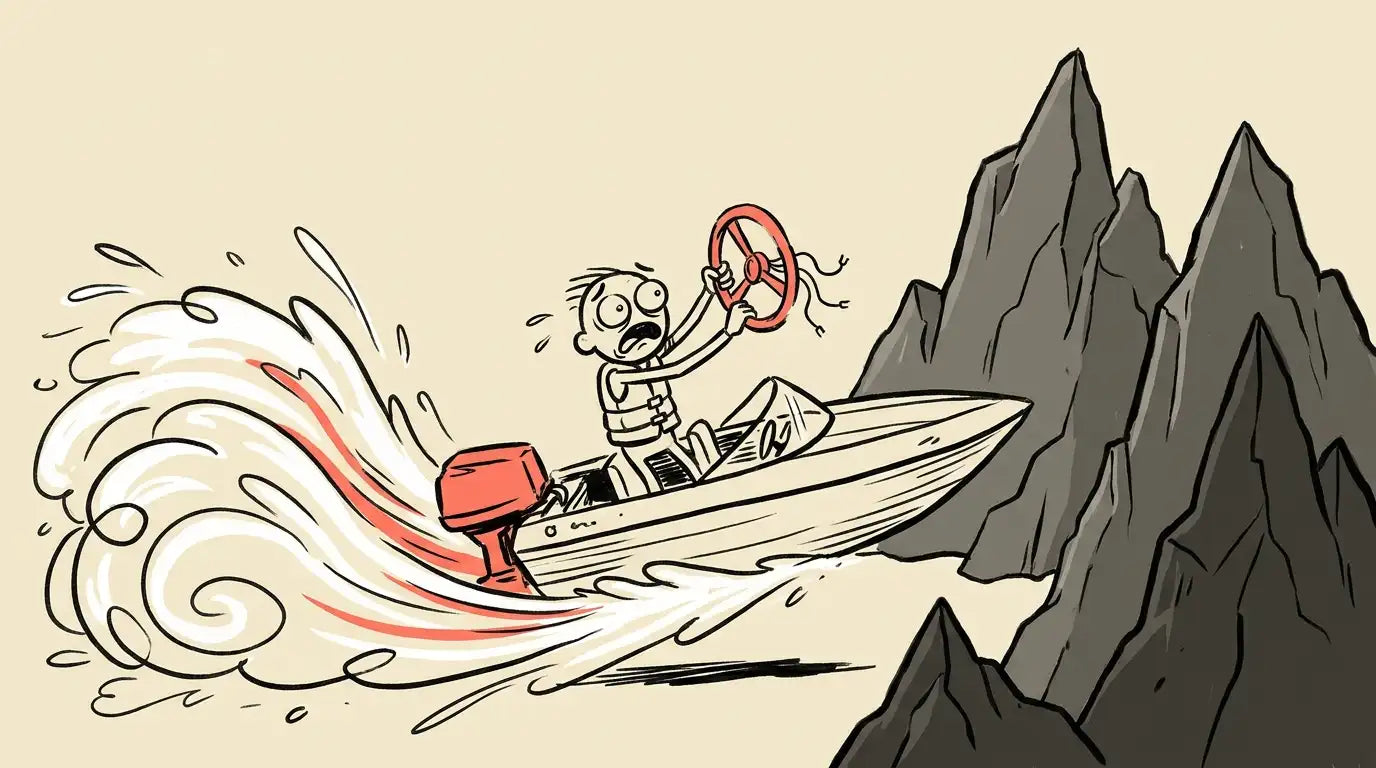
So what's the steering wheel actually made of?
It's your reward system.
Because your mood and focus run on the same wire.
The chemical behind feeling good — dopamine — is the same one behind concentration.
One chemical. Two jobs.
Established neuroscience, not marketing — studies are at the bottom of this page.
Your brain only holds attention for what it likes.
So lift your mood, and focus gets turned on together.
Let it drop, and focus is the first to go.
It's why work feels easy on a good day.
And impossible on a bad one.
I know you know this feeling.
Once you realize this, focus stops looking like one thing. It's three parts:
- Activation — awake. Switched on enough to engage. (The only part caffeine touches.) You do need it — caffeine isn't useless; it plays a real part.
- Pull-back — calm. Eased back to the sweet spot — steady enough to stay on task, not vibrate out of your chair. It keeps alert from tipping into jittery.
- Reward — want-to. Your brain has to want the work. Or it drifts back to your phone. (The mood piece — the dopamine piece.)

Awake without calm? Wired and useless.
Calm without awake? Fog.
Awake and calm, but no mood? You sit there fully caffeinated, doing everything except your task.
A good mood and a sharp head, firing together.
It shows up only when all three line up at the same time — in one dose.
But nothing out there has ever delivered all three together.
That was the problem.
Why more energy backfires.
Start with why "just caffeine alone" fails.
There's a curve two scientists drew back in 1908. Focus rises as you get more alert — but only up to a peak. Push past it, and focus falls again. Sharp, then twitchy, then scattered.
Remember that web?
That was caffeine. In that NASA study, it left a more broken web than some genuinely terrible illegal substances did. (Real study — you can look it up.)

And I know. We're not spiders.
But there are human studies that land in exactly the same place — a lot of them. The pattern repeats across study after study: a little caffeine sharpens you. Too much pushes you past the peak and starts degrading the very focus you reached for. A few:
Caffeine tracks an inverted-U: it lifts focus up to a point, then over-arouses you and makes it worse. Shown for caffeine specifically.Watters, Martin & Schreter, 1997
In a randomized, double-blind, placebo-controlled trial, a caffeine dose impaired spatial working memory in regular coffee drinkers.Randomized controlled trial, 2024 · [author to lock]
Before a demanding test, caffeine slowed reaction time and lowered accuracy on the toughest trials — the researchers' own word was "detrimental."Placebo-controlled crossover · [author to lock]
A major review of caffeine and performance: low doses help — but past ~400 mg (about four coffees), most people tip into anxiety, nerves and jitter, and performance can fall.McLellan, Caldwell & Lieberman, 2016
Coffee is a sledgehammer.
The first cup can carry you toward the peak.
The second and third throw you clean over it — then burn off and drop you below where you started.
The crash.
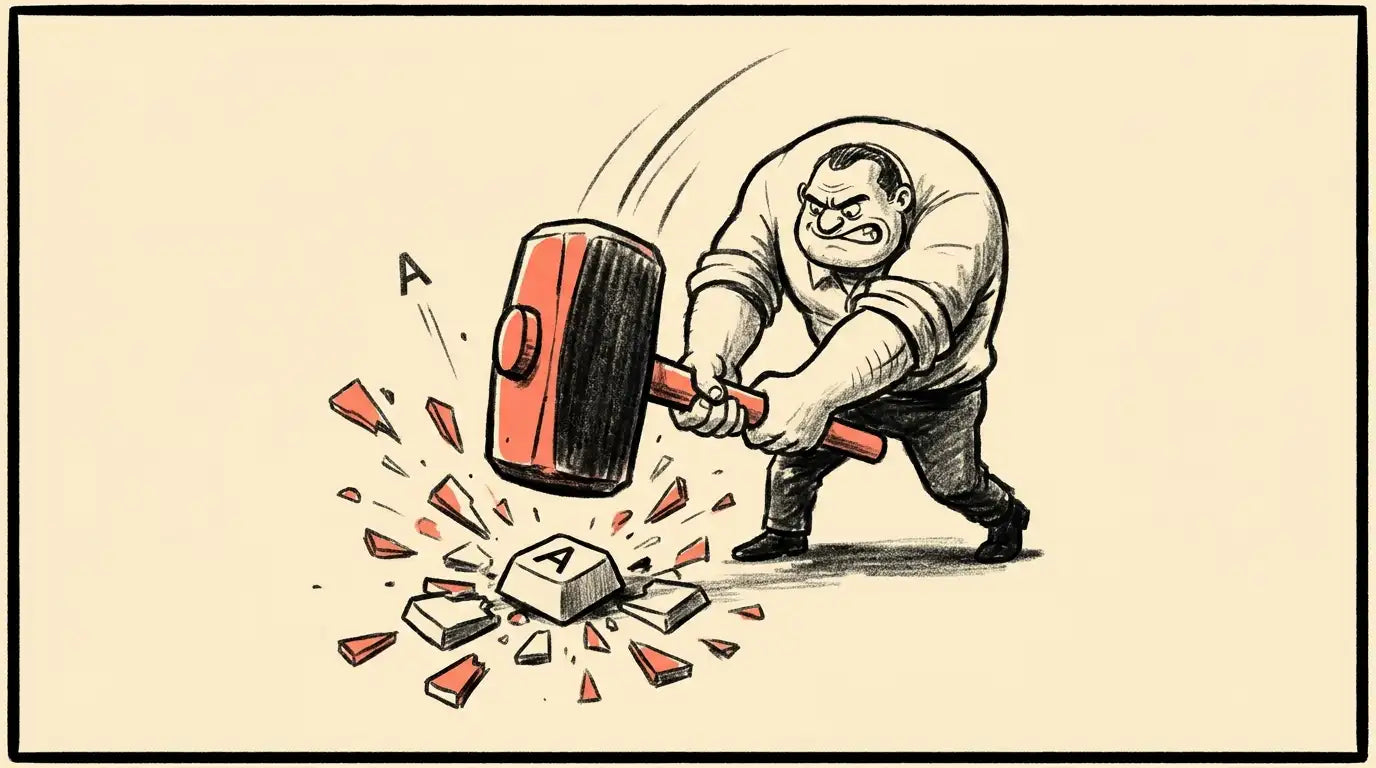
So "more" was never the answer.
And that takes more than one ingredient.
The five, together.
Five ingredients, to be exact. Each with a single job. Together they Activate, pull back, and Reward your focus — then extend it and fuel it:
- Caffeine — Activation. Brings you up toward the peak.
- L-theanine — Pull-back. Lifts the brain's relaxed "alpha" rhythm and takes the edge off the caffeine, pulling you back so you land right on the peak instead of flying past it. (In head-to-head trials, the pair beats caffeine alone.)
- Saffron — Reward. The good-mood layer that makes the task feel worth doing.
- Theobromine — the long tail. Holds the whole thing for hours, because it clears out of you slowly — so the focus eases down instead of falling off a cliff.
- B6 & B12 — the fuel. Keep the energy steady underneath.
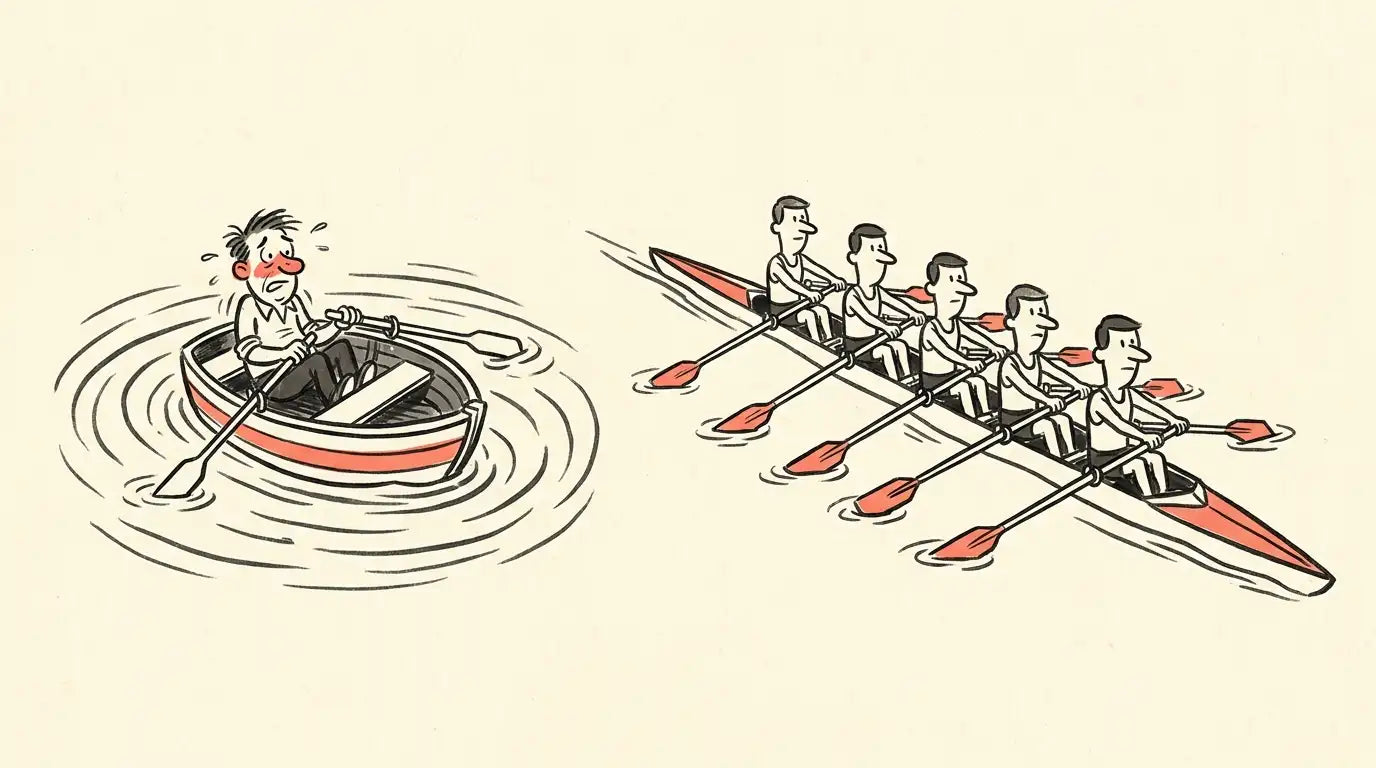
That's the state, finally whole.
And here's the beautiful part: on their own, they don't do that great a job at helping your focus. It's only together — in the right doses, in the right order — that they turn into something none of them could ever be alone.
What it actually feels like.
It doesn't matter what the task is — a house chore, a work project, studying for an exam. The same thing happens.
You sit down, and you start.
No warm-up.
No three-tabs-first.
No negotiation.
The order just shows up. You know what to do first, second, third.
No analysis paralysis. No freezing at the size of it.
You chip in right away.
You couldn't say why.
You just begin.
The noise in your head drops. You settle into the chair.
And without deciding to, you find yourself wanting to keep going.
Then time does something odd.
You look up and an hour's gone — except this time you spent it inside the work, not hiding from it.
Somewhere in there, the focus itself starts to feel good — the way a runner's high kicks in once you're past the first mile.
Coffee is the ocean: all crash and churn and spray. This is still water. A garden, birds somewhere, nowhere you'd rather be. You almost don't want to move — you just want to stay here, in it, and keep going.
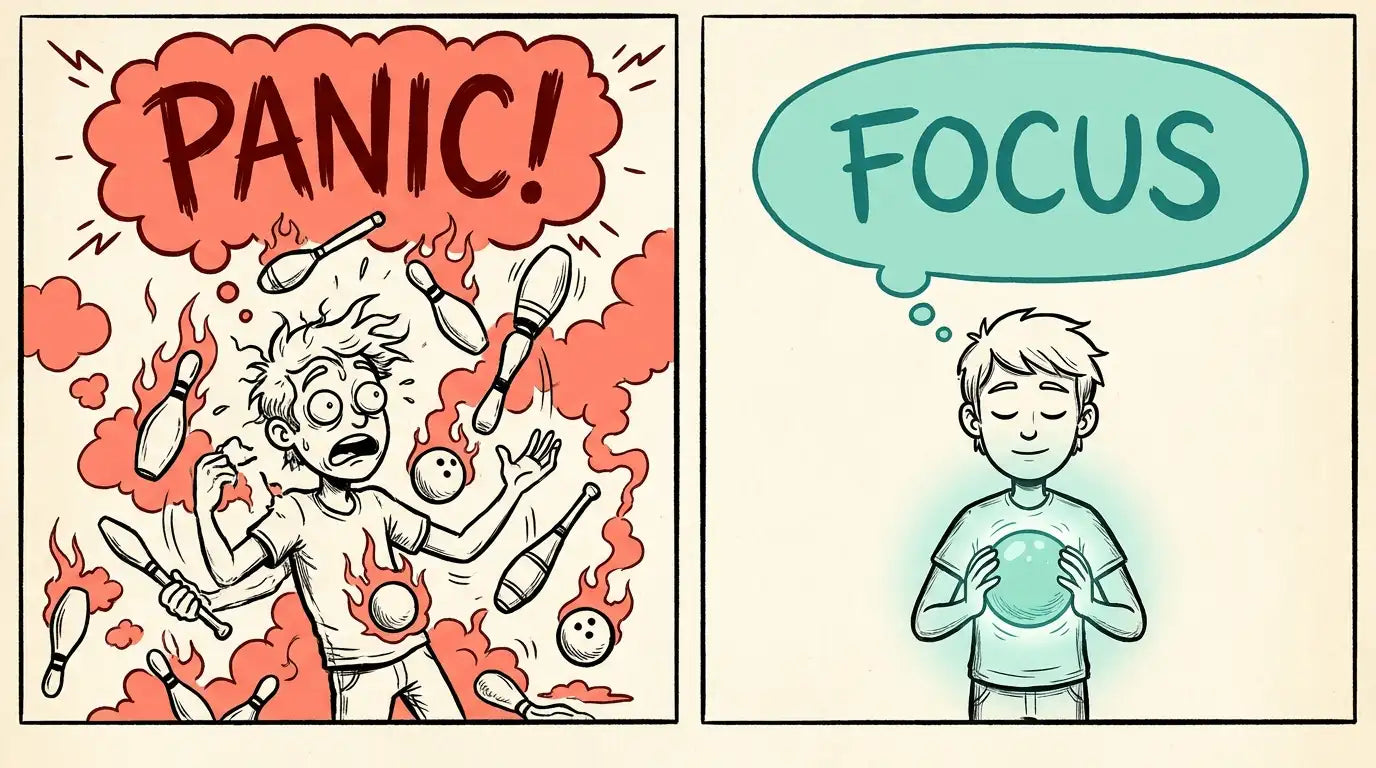
That's the feeling people keep reaching for and missing.
Calm on the surface.
Locked in underneath.
There's a name for it.
Happy focus.
And you feel it the first time, within minutes — not a week in.
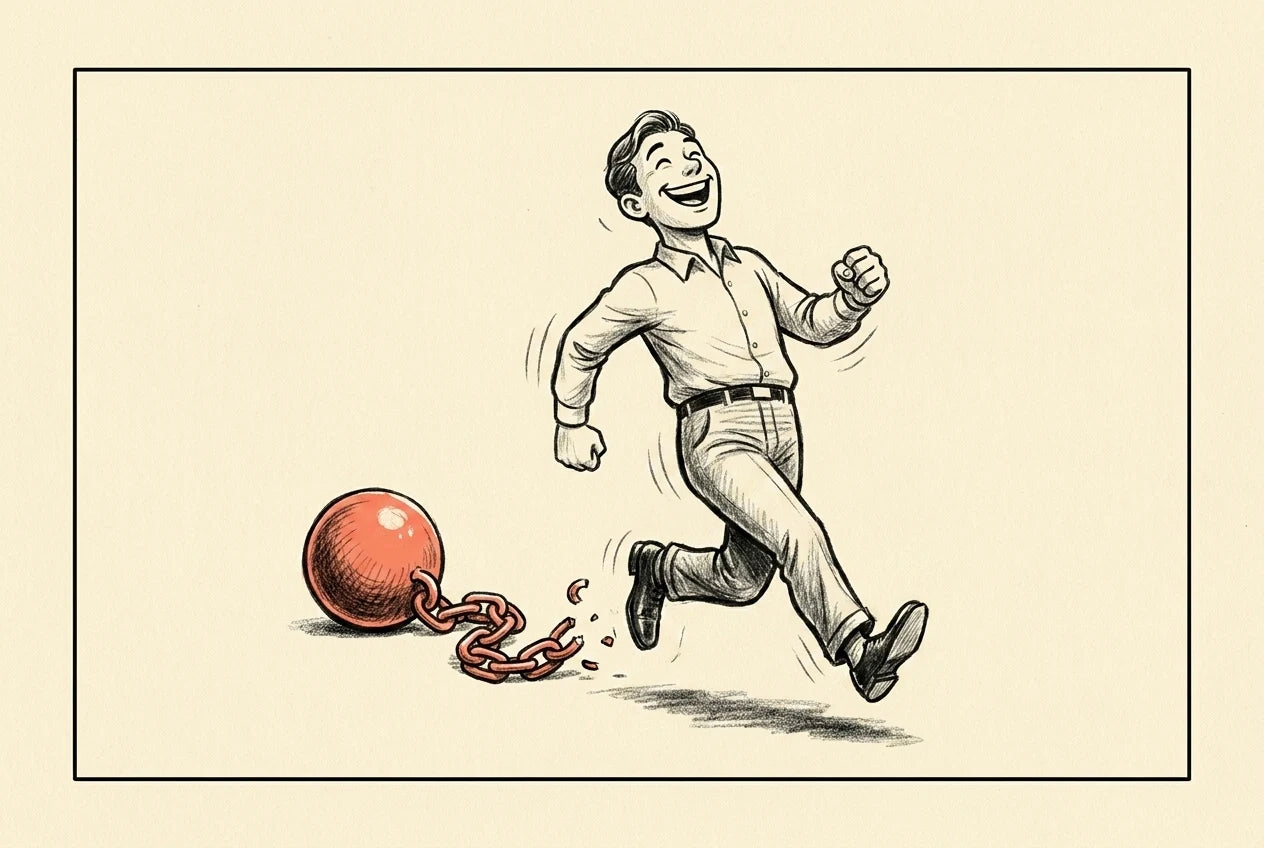
None of this is a hunch.
It's been measured — in real people, by real scientists, in the journals doctors actually read.
Across multiple randomized trials, and the meta-analyses pooling them, the combination improved alertness and attention more cleanly than caffeine alone.Kelly et al., 2008 · pooled across 2 meta-analyses
One of the most-studied botanicals for mood: multiple independent meta-analyses, dozens of trials, a large effect at the 30 mg dose — the exact amount the trials themselves used.23-trial meta-analysis, 2022
It clears far slower than caffeine (a 7–12 hour half-life vs caffeine's 3–5), which is why the lift eases down for hours instead of crashing.Baggott et al., 2013
The reason a good mood sharpens concentration: the two run largely on the same brain chemical — which is why a focus formula that ignores mood is only doing part of the job.Ashby & Isen, dopaminergic theory of positive affect, 1999
The last piece isn't what's in it. It's how you take it.
You can't schedule when you'll need to focus. So whatever the answer is, it has to already be on you — not a drink can, not a bag of gummies, not something you brew, and definitely not something you have to spit out.
Focus has to come in the smallest, quietest form there is.

It dissolves under your tongue. No water, no chewing, nothing to swallow, nothing to spit out, nothing to hold.
And that's not for show — it's how it works. Dissolving in the mouth lets it absorb right there, fast, instead of waiting on your stomach.
Because when you're finally locked in, the last thing you want is friction. Breaking flow to swallow a pill, mix a drink, find a bathroom. Something parked against your gum for an hour — and tobacco, or anything you'd inhale, is well documented to be hard on teeth and gums over time anyway.
None of that. Just something small, clean and silent. It fits in a pocket. Nobody around you notices. And it's there the second focus is.
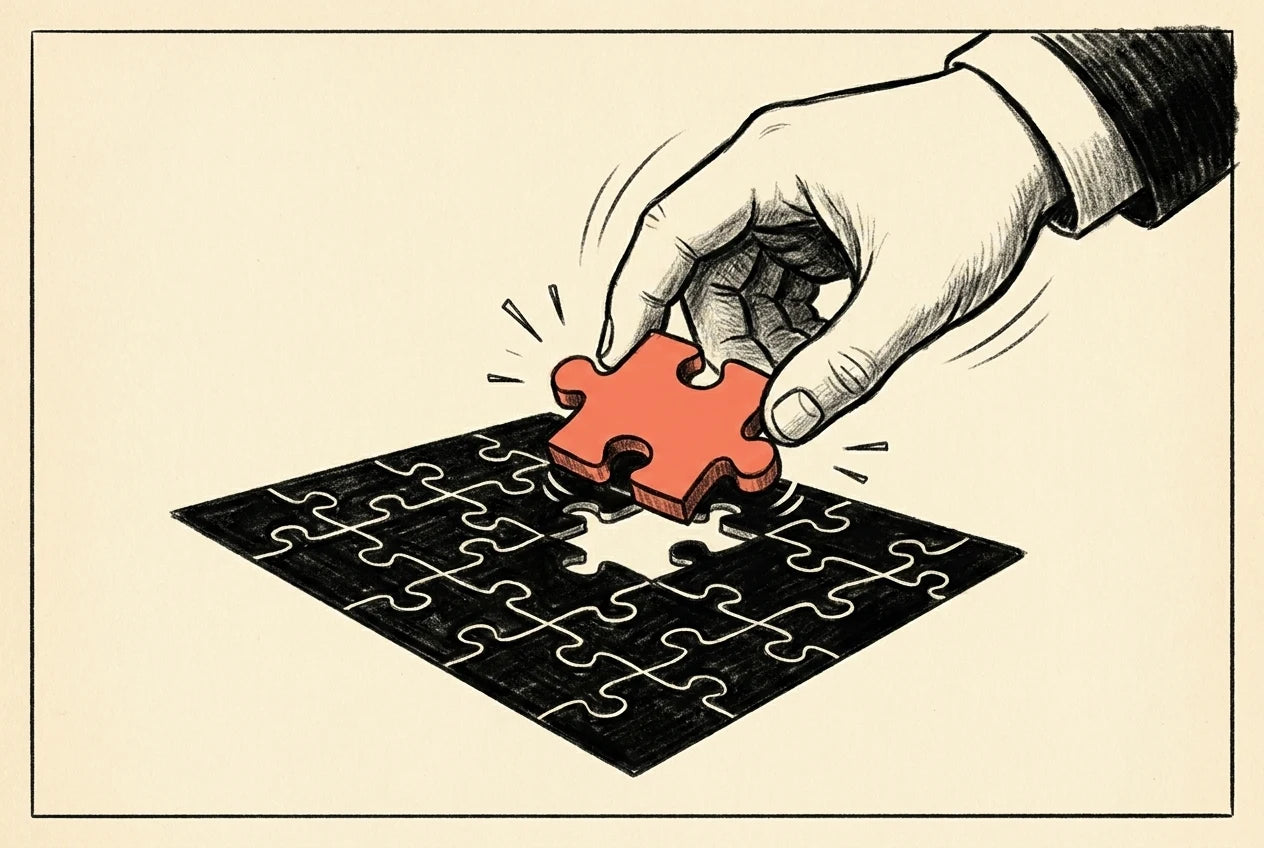
That's the whole idea.
You don't have a focus problem. You were handed one lever and told it was the whole machine.
It was always three — together, on the peak, and held there.
Master that, and you quietly become the one who out-focuses the room — while everyone around you is still reaching for a third coffee. It's the kind of edge that works best while hardly anyone else has caught on.
The thing that does all three at once — quietly, in something smaller than a coin — already exists.
If you'd like to see it for yourself, it's right here.
Watters, Martin & Schreter (1997) — caffeine & the nonlinear Yerkes–Dodson law — Human Psychopharmacology
McLellan, Caldwell & Lieberman (2016) — review of caffeine's effects on cognitive, physical & occupational performance
Kelly et al. (2008) — L-theanine + caffeine & attention — J. Nutrition · PMID 18641209
Baggott et al. (2013) — psychopharmacology of theobromine — Psychopharmacology · PMID 23420115
Ashby & Isen (1999) — a neuropsychological theory of positive affect & its influence on cognition
23-trial saffron–mood meta-analysis (2022); caffeine working-memory RCT (2024) — [full author/PMID to lock before ship]